Rén-Yin-Yang-Rén
The yang leaves its yin, the yin leaves its yang,
and things go wandering with nowhere to be.
1
He leaves the deep spirit-pool.
He puts up in the dry garden on the hill.
He did not go by way of the low ground.
2
He leaves the dry garden.
He puts up in the deep pool underneath it.
The road that goes down is the one that shines.
3
He lengthens his stride to get up to the hall.
The dew comes off the grass onto his clothes.
He is walking where nobody asked him to walk.
4
He goes from being the son to being the father.
He goes from the minister’s place to the lord’s.
None of this was anything he had hoped for.
5
He gathers up his robe to walk.
There are deer standing in his own courtyard.
This is a thing to be frightened of.
6
The work is finished and he takes himself away.
Heaven leaves the name behind him.
He got it by not staying to hold it.
7
He walks away from the straight thing in himself.
He could die three times and the name would not come clean.
The dying is the ugly part and it is not the end of it.
8
The moon stands at the half, high up.
The Fire Star is almost down.
Nothing should move now; whatever moves is at fault.
9
They come looking and he is not there.
He went out by the northwest.
How was any of it going to last?
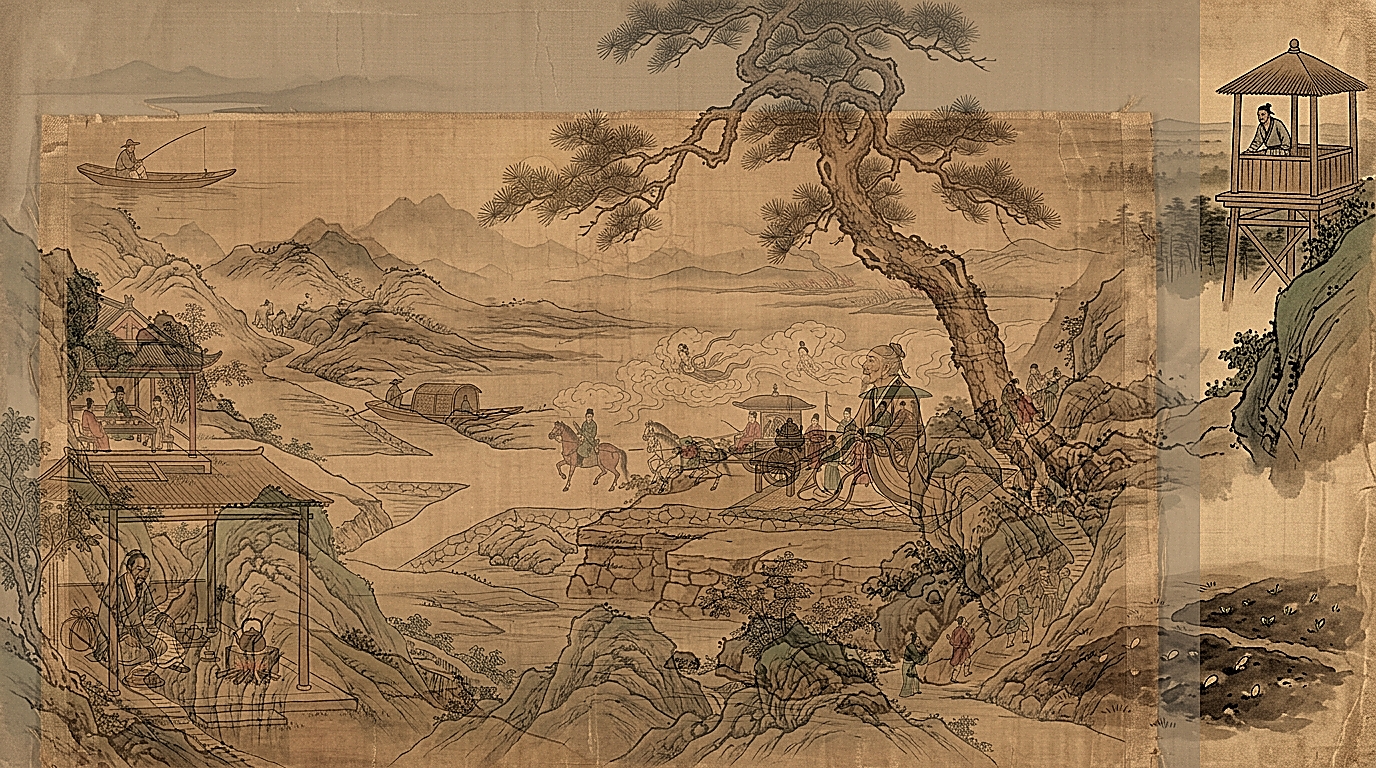
THE IMAGE
An ancient mountain pass gateway in autumn frost, where horse caravans and a serene traveler say farewell to companions, riding steadily forward along the winding road into open horizons.
THE COMMENTARY
Something is leaving its accustomed place. A person, role, condition, identity, or phase may be separating from what once complemented and contained it.
Departure can be necessary even when it creates disorientation. Sometimes leaving restores a deeper alignment; at other times movement is merely wandering because the old relationship has been broken without a new one being found.
Do not assume that going away is either betrayal or liberation. Ask whether departure completes the work, abandons it, or simply responds to a season that has already ended. What you leave behind may carry your name longer than your presence would have.
This figure is one of 81 in Taixuanjing for Today, a book by Joe Perez that renders Yang Xiong’s Canon of Supreme Mystery in original verse, with expanded commentary, essays, and full instructions for casting the oracle yourself.