Rén-Yang-Rén-Rén
The yin completes the dark of the moon, the yang completes its mate.
Every shape a thing has can now be looked at.
1
He keeps the brightness on the inside.
He does not spend the light of it.
He is looking a long way down into himself.
2
The gentleman looks inward.
The small man looks out.
One of them cannot find the heart of anything.
3
They look at what he actually is.
It is enough to hold up a corner of the kingdom.
Nothing has to be added to him.
4
He powders his forehead and his cheekbones.
It rains, and the wet runs down into his beard.
Nobody can go on looking.
5
Phoenix and simurgh, thick as weather.
What he is gives off a light.
The birds came for the light and not the man.
6
A plain cart under a kingfisher-feather canopy.
The damage is done by looking.
Look straight at it and the two halves come apart.
7
He looks straight at the flaw in himself.
Nothing goes rotten.
The looking was the straightening.
8
The kingfisher flies and is parted from its wings.
The fox and the marten are robbed by their own coats.
What is admired about them is what kills them.
9
The sun puts its light away and the east goes bright.
The last of it falls where the first of it rose.
The end turns round and looks at the start.
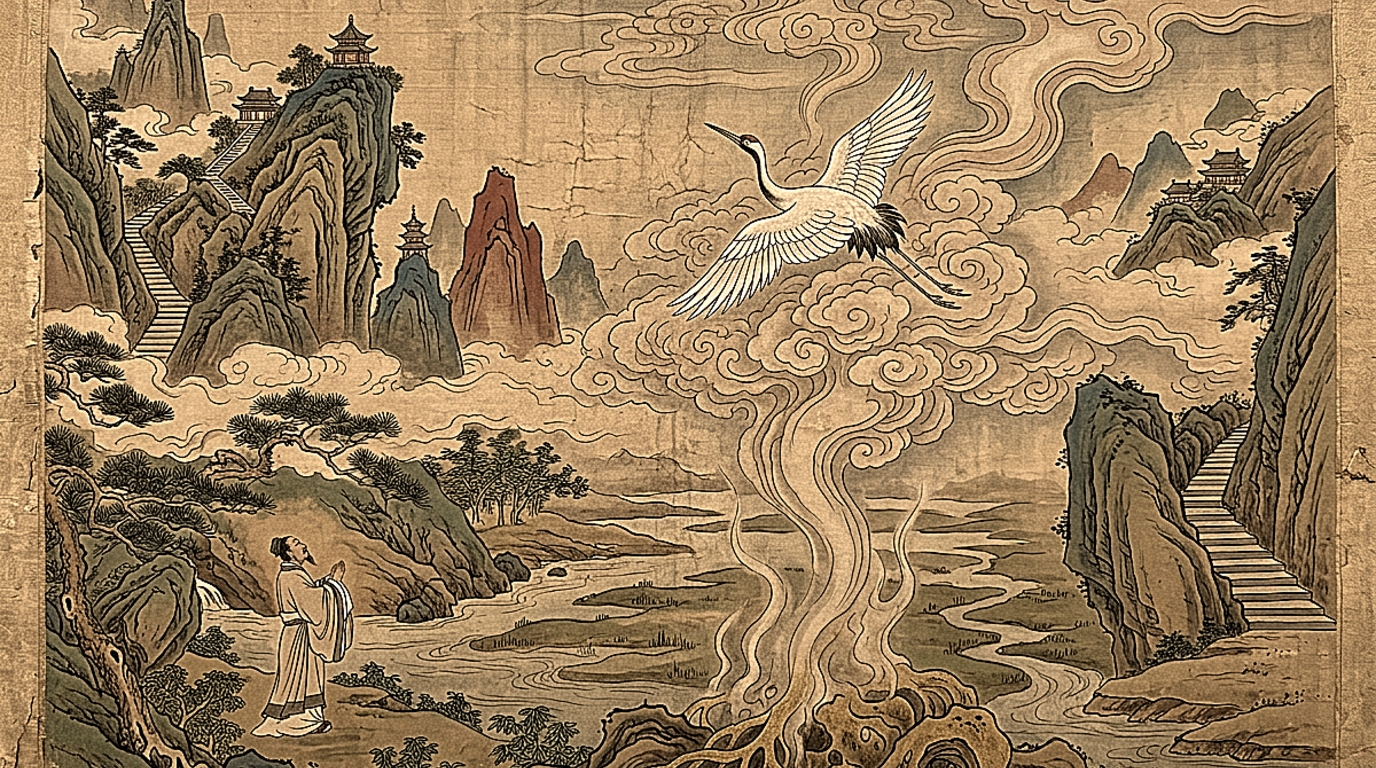
THE IMAGE
An observatory platform perched high on a granite cliff, where astronomers view constellations and celestial alignments through armillary spheres under clear autumn starlight.
THE COMMENTARY
The situation asks to be seen clearly. Observation, self-examination, reputation, appearances, and the difference between looking outward and looking inward may all be important now.
What you see depends partly on where you stand and what you are willing to examine. Looking only outward can produce fascination, envy, or misjudgment, while looking inward may reveal the flaw that can still be corrected before it spreads.
Visibility itself also carries risk. Qualities that attract admiration may attract exploitation, and beauty or distinction can become liabilities when they are valued apart from the life that bears them. See what is actually there, not merely what invites attention.
This figure is one of 81 in Taixuanjing for Today, a book by Joe Perez that renders Yang Xiong’s Canon of Supreme Mystery in original verse, with expanded commentary, essays, and full instructions for casting the oracle yourself.