Rén-Yang-Yin-Rén
The yin is about to shut everything; the yang keeps one small opening.
Mountain, river, marsh and fen — this is where things go to be stored.
1
He piles it up wrong, in the dark.
It becomes the foundation of what happens in daylight.
The beginning of it was already the bad part.
2
He piles it up and it is never used.
Then it is used greatly.
Nothing about the size of it could be measured beforehand.
3
He heaps up stones and cannot eat them.
The work goes out of him.
Nothing comes back the other way.
4
He heaps up good acts until they show.
They stand up like the side-boards of a cart.
It has got past the point of being invisible.
5
He stores and stores and it is never full.
He is stocking the thief’s share.
Everything piled here is piled for somebody else.
6
Full to the top, and giving it out by the armful.
People come to him.
There is nobody standing opposite him any more.
7
He stands out at the head of it, face showing.
The jade and the silk are laid out in rows.
This is how a man sends for thieves.
8
He piles up good acts and the reckoning comes anyway.
The debt was run up before him.
Nothing here is his.
9
The small man piles up the wrong things.
It reaches as far as the grandchildren.
The heap is where the harm settles.
THE IMAGE
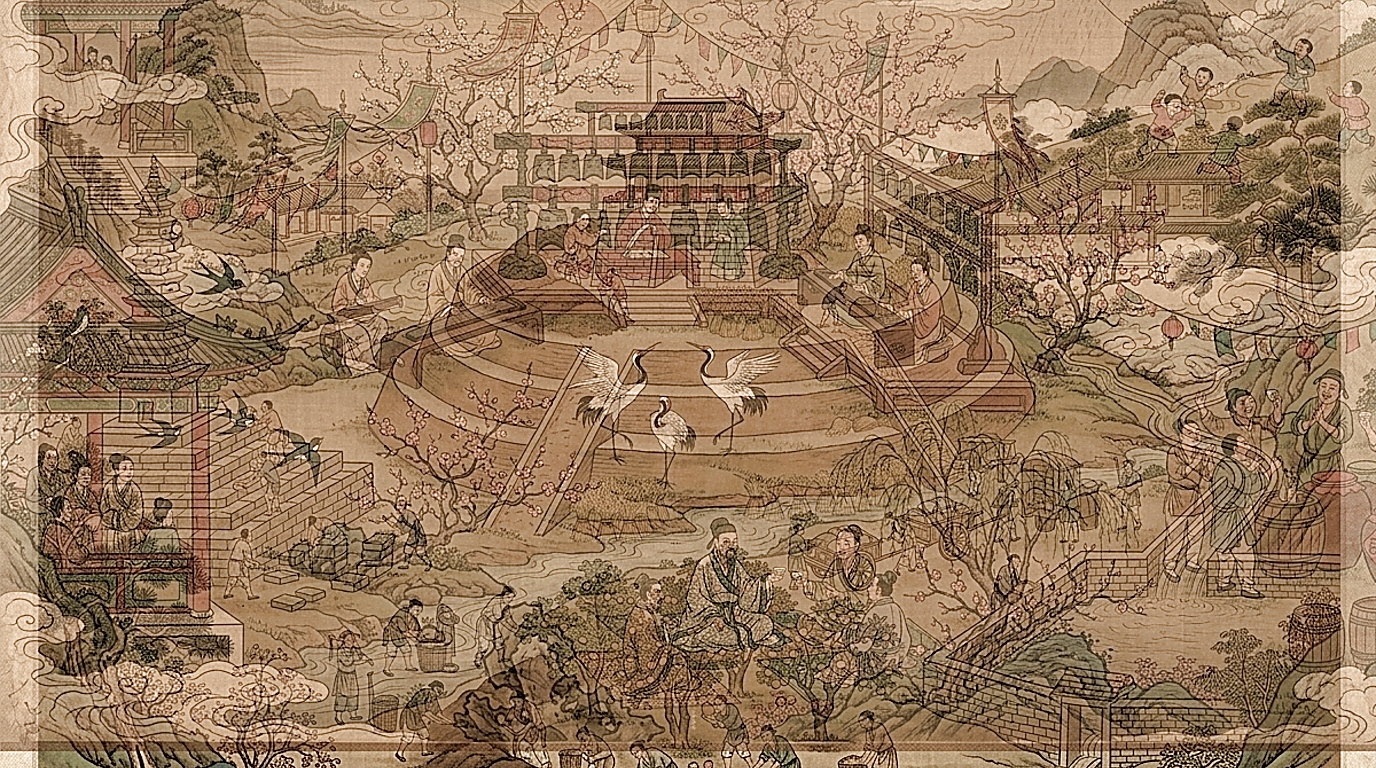
An ancient library and terrace overlooking a valley where master stonemasons lay square ashlar stones onto a rising pagoda base, while archivists arrange thousands of indexed bamboo scroll rolls on sandalwood shelves.
THE COMMENTARY
Something has been building over time. Resources, habits, consequences, knowledge, goodwill, resentment, or unfinished obligations may have accumulated until the size of the whole can no longer be understood by looking at any single contribution.
Accumulation magnifies the character of what is stored. Good preparation can become a reservoir that serves many people when the moment for use arrives; neglected faults can also pile up until later generations inherit what no one intended to leave them.
Ask what you have been adding to, consciously or otherwise. The important question is not merely how much has accumulated, but whether what has been stored will eventually nourish, burden, tempt, or protect those who come into contact with it.
This figure is one of 81 in Taixuanjing for Today, a book by Joe Perez that renders Yang Xiong’s Canon of Supreme Mystery in original verse, with expanded commentary, essays, and full instructions for casting the oracle yourself.