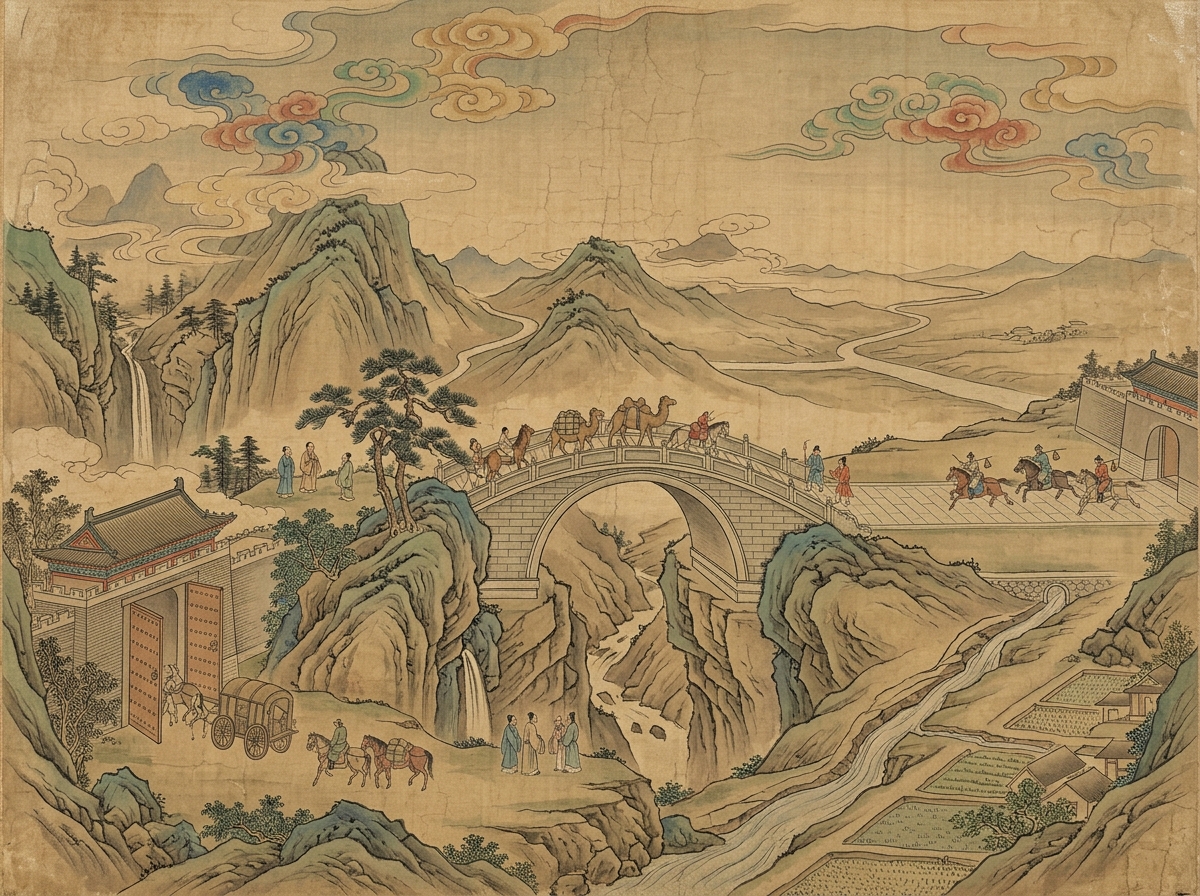
Yang-Yin-Yin-Rén
The yang breath comes out branch by branch, twig by twig.
There is nothing it fails to get through.
1
Alone in the dark middle, he gets through.
Far out and far out, and never bent.
The knowing inside him has no edges.
2
The belly is lost, the eyes get through.
He looks out and cannot look in.
He trusts the seeing because the road went dark.
3
The old tree lets its branches hang low.
Its goodness gets as far as the gourd vine.
It measured with what it had inside it.
4
Small gain, small reach.
Lost on the large scale, narrow and narrow.
He knows one corner and calls it the country.
5
He gets as far as the central crossing.
Nothing large or small is lost there.
The road goes out four ways at once.
6
Reaching everywhere, with no boundary anywhere.
He does not stop to dig the channel.
Blocked. No one can follow in all directions.
7
It gets through by the stone lancet.
First the losing, then the leaning on.
The cut is what was kept.
8
The eyes are lost and the belly gets through.
What he knows, he knows without looking.
The outside got in and muddied it.
9
He gets all the way to the fault.
Upright, and praised at the end.
He knew the road well enough to go back down it.
THE IMAGE
An ancient stone bridge arching gracefully over a once-impassable rushing canyon gorge, connecting distant mountain realms with open trade highways under an expansive clear sky with auspicious rainbow-hued clouds.
THE COMMENTARY
A way is opening. Communication, understanding, influence, movement, or access may now extend farther than before, allowing something to pass through barriers that once seemed substantial.
But reaching is not the same as grasping everything. The oracle distinguishes genuine penetration from mere breadth. To reach well is to understand where the channels actually run, not simply to spread yourself in every direction.
This figure encourages connection while warning against dispersion. You may be capable of going farther than you have gone before, but usefulness depends on knowing where to stop, where to return, and what must remain connected to the center.
This figure is one of 81 in Taixuanjing for Today, a book by Joe Perez that renders Yang Xiong’s Canon of Supreme Mystery in original verse, with expanded commentary, essays, and full instructions for casting the oracle yourself.