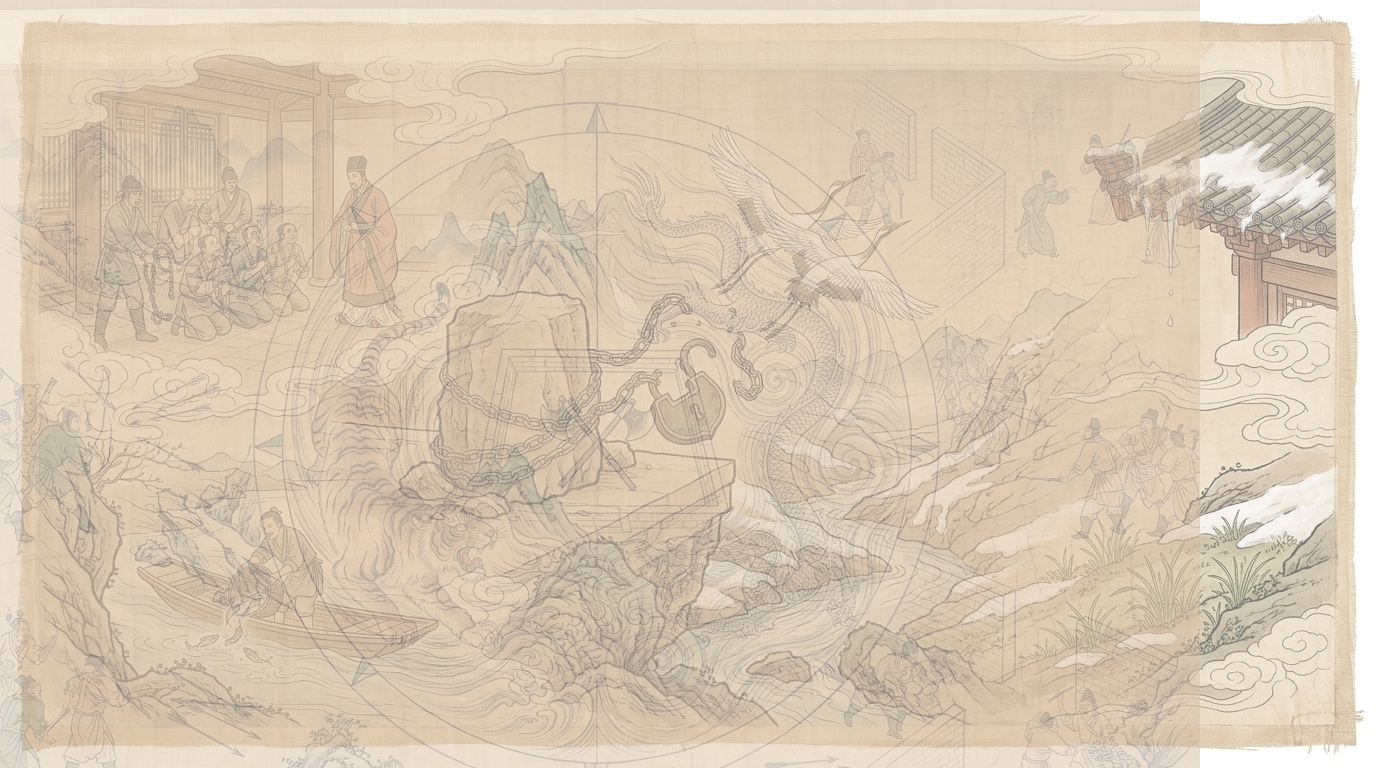
Yin-Rén-Yin-Yang
The yin breath comes out strong and plain.
The yang slips away in secret, and things are about to be lost.
1
He goes off into the water and the water goes flat.
The cut he made in it closes.
Nobody can say where he went in.
2
His heart is afraid and afraid.
His shoes are made of metal.
He does not notice the ditch under them.
3
His legs shake. He is whipping the horse.
The raiders are already looking at his door.
This is the hour when leaving pays.
4
The tall tree stands thick at the top and the bird flies past.
Some of them stop and come down anyway.
Whoever wants to land will find a branch.
5
The kite comes down into the wood, the otter goes into the pool.
Go now.
What eats here has just arrived.
6
He owns a great deal of land and works none of it.
The food goes, the labour goes.
Nothing comes up out of any of it.
7
He is already in the snare when they see him.
Afterward he gets away flying.
It was very close, and it was not high.
8
The line is around his neck.
He beats his wings against the string.
There is no use in the effort.
9
He goes, limping and limping, and it is right to go.
The thieves have the city ringed.
It never had to come to this.
THE IMAGE
A discerning hermit scholar in simple coarse linen robe walking along a misty mountain path away from a chaotic burning fortress valley, carrying only a bamboo walking staff and zither, climbing toward serene pine peaks.
THE COMMENTARY
Withdrawal may now be wiser than confrontation. Something is being lost, threatened, or overtaken, and staying in place merely to prove courage can leave you trapped inside conditions that are already deteriorating.
Retreat is not necessarily defeat. Leaving at the right time preserves what can still be carried into another place, while delaying out of pride can turn an orderly withdrawal into desperate escape.
Know what you are leaving and why. Fear can make a person flee too early, but denial can make them remain until every exit is compromised. The wisdom here lies in recognizing the hour when departure preserves more than resistance would.
This figure is one of 81 in Taixuanjing for Today, a book by Joe Perez that renders Yang Xiong’s Canon of Supreme Mystery in original verse, with expanded commentary, essays, and full instructions for casting the oracle yourself.