Yang-Yin-Rén-Yin
The yang breath can be hard and can be soft, can work and can rest.
Seeing difficulty, it draws back.
1
The red shoots are just coming to a point.
Go forward by going back.
The drawing-back is the movement.
2
He lets his heart go soft.
It turns into an illness.
There was nothing standing up inside him.
3
He softens the knee and keeps the joint.
He never stretches all the way out.
Nothing in the end goes against him.
4
He softens the sound in his throat.
Three years and the beak does not close.
He has lost his place in the counting.
5
The yellow fungus does not put out.
It waits for the lucky cloud.
It is waiting for the other half of itself.
6
He shrinks and the hour goes past.
The disaster comes to him anyway.
He sat still and arrived late.
7
He bends at the joint and keeps hold of the method.
They go together all the way to the end.
Something inside him is doing the holding.
8
A hollow dead tree, and a man shaking the branches.
The small man has gone soft.
Driven back three times, hooked, and netted.
9
He regrets having drawn back.
He goes off, and returns.
Whatever is gained is gained on the way back.
THE IMAGE
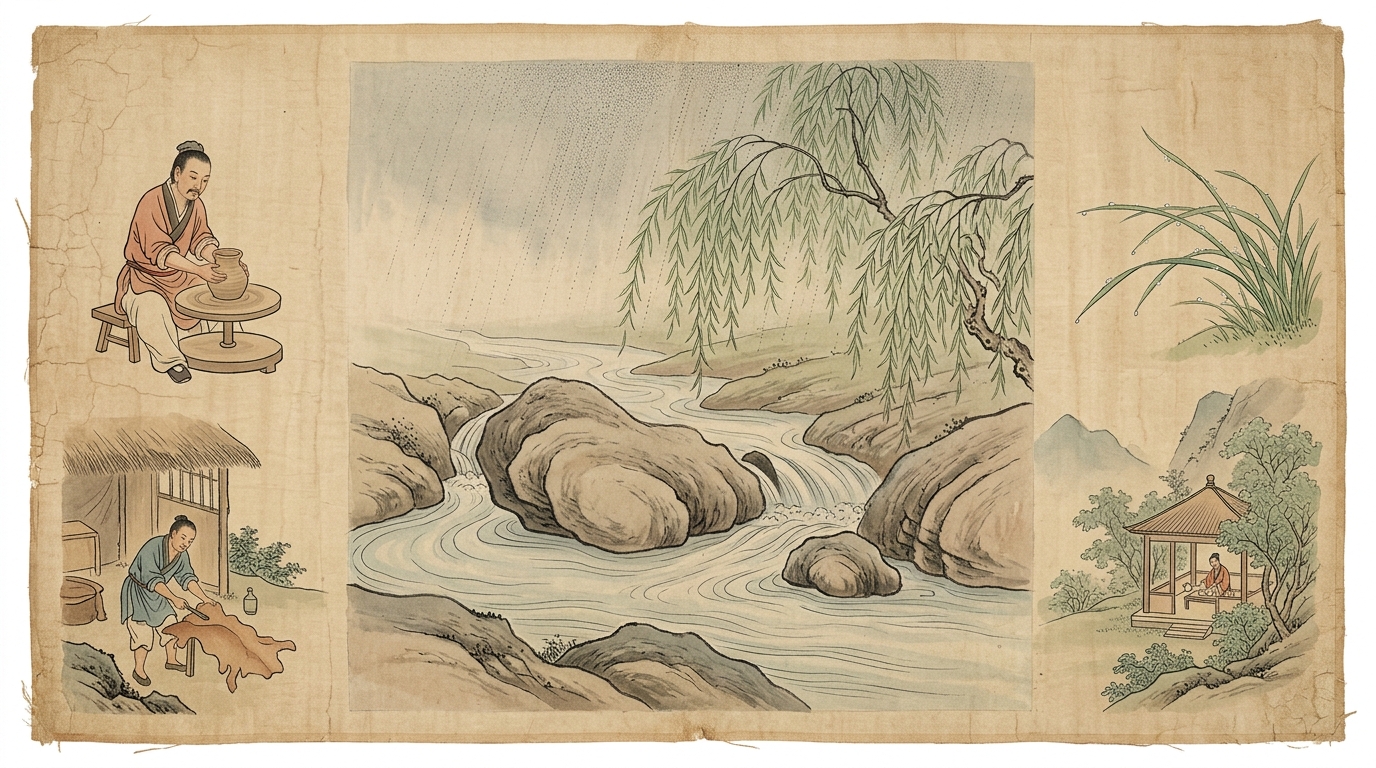
Clear spring water gently flowing around and smoothing hard river granite boulders without force, accompanied by supple green willow boughs bending gracefully before misty spring rain.
THE COMMENTARY
The moment calls for flexibility. Resistance may be costing more than it protects, and a deliberate step back may create more room for movement than pushing forward would.
Yielding is not surrender in the weak sense. The oracle distinguishes between bending intelligently and collapsing inwardly. What yields well preserves its structure, while what simply gives way may lose the very center that made flexibility possible.
There are situations in which retreat, patience, softness, or accommodation are the strongest available actions. But yielding must remain connected to purpose. Bend where bending preserves the path; do not become so pliable that you forget what the path was.
This figure is one of 81 in Taixuanjing for Today, a book by Joe Perez that renders Yang Xiong’s Canon of Supreme Mystery in original verse, with expanded commentary, essays, and full instructions for casting the oracle yourself.