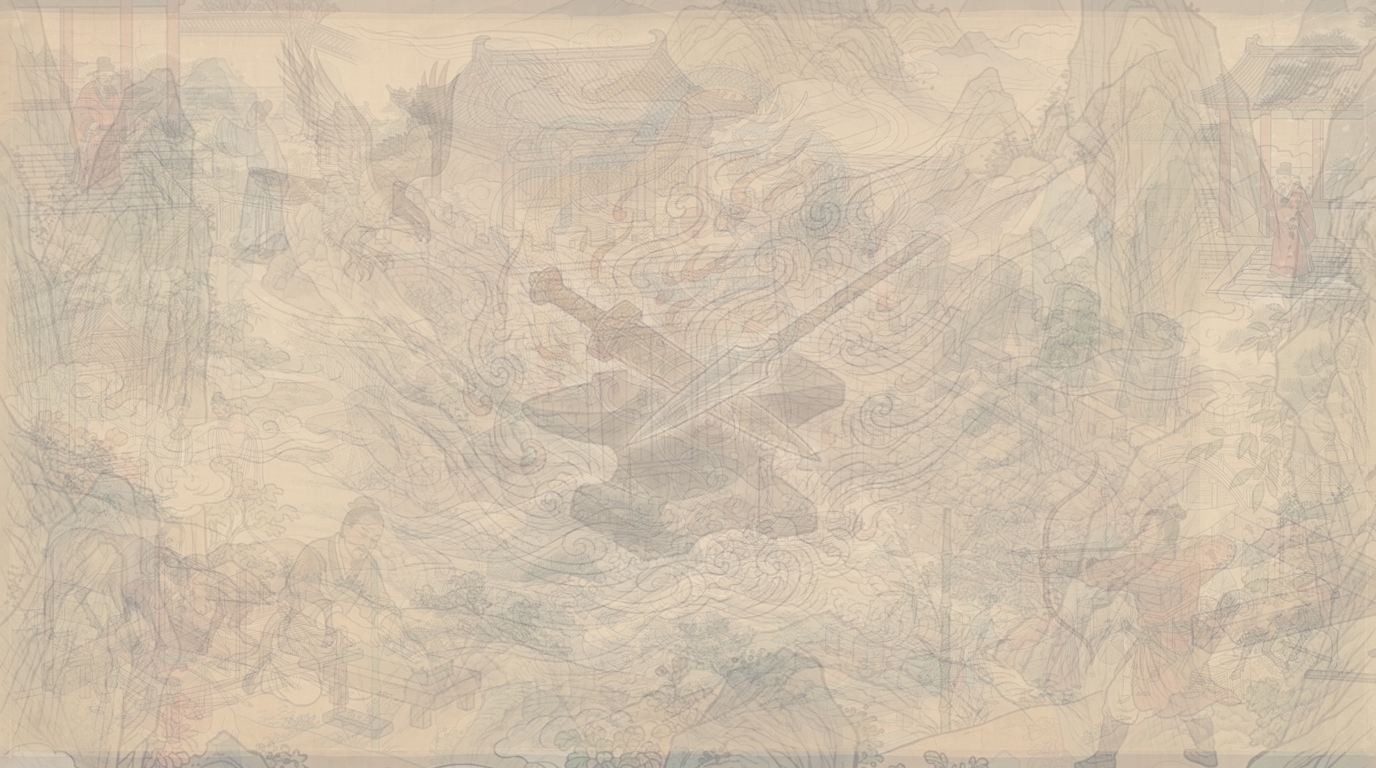
Yin-Rén-Rén-Yin
The yin takes by arms, the yang gives by pattern.
Between them a way can last.
1
Nobody set aside, nothing out of true.
The eldest keeps his place.
This is how a house goes on being a house.
2
Inside, he is already thinking of replacing him.
What was straight and lucky goes.
How long was that ever going to hold?
3
He makes the road last.
He has not got anywhere on it.
There is nothing in that to be blamed for.
4
The son is not standing where the son stands.
The guests come and there is no one to receive them.
The offerings are set down in front of nobody.
5
The three cords are tied at the center.
Heaven keeps what it gave.
Everything hangs from the same knot.
6
He means the good fortune to go on and on.
He comes back and the courtyard is empty.
Ripeness has a dark on the other side of it.
7
The old tree puts out a shoot from its side.
It goes on by growing what it never had.
It is longer now than it was young.
8
He goes on and on outside the rule.
The ruin does not stop with him.
It runs downhill into the children.
9
He comes to the end still going the way he set out.
Easy, and glad, the whole length of it.
The last day looks like the first.
THE IMAGE
An immortal white crane soaring above ancient cedar forests and mist-veiled mountain springs, where scholars in secluded pavilions carve philosophical inscriptions into living granite cliffs beside perennial lotus pools.
THE COMMENTARY
The question concerns duration: what can continue, what deserves to continue, and what must change if continuity is to remain alive rather than become mere persistence. Something is asking to be carried beyond the present moment.
Enduring depends on right relationship among the parts. Roles, responsibilities, traditions, and commitments can last when they support one another across time. When inward loyalty has already shifted, however, the appearance of continuity becomes fragile.
Do not confuse lasting with never changing. Some things endure precisely because they grow new branches, adapt to age, and allow continuity to express itself through forms that did not exist at the beginning.
This figure is one of 81 in Taixuanjing for Today, a book by Joe Perez that renders Yang Xiong’s Canon of Supreme Mystery in original verse, with expanded commentary, essays, and full instructions for casting the oracle yourself.